Wednesday, May 9, 2012


Wednesday, April 18, 2012
Man Locked In House Burned To Death In Foreclosure Eviction Shoot Out With Cops
http://blog.alexanderhiggins.com/2012/04/13/man-locked-house-burned-death-foreclosure-eviction-shoot-cops-117971/
Police say the man then locked himself inside the house resulting in a standoff with police during which police flew flash grenades, tear gas and other concussive explosive devices into the apartment for over an hour in an attempt to force the man out.
The result of the chaos was a fire during the which the man was burned to death.
CNN reports:
A man being evicted from his house shot a deputy and a locksmith and then locked himself inside and was later burned alive after police grenaded the house for an hour.
Police say a man shot a sheriff’s deputy and a locksmith when they tried to evict him from the his apartment which was being foreclosed on.Police say the man then locked himself inside the house resulting in a standoff with police during which police flew flash grenades, tear gas and other concussive explosive devices into the apartment for over an hour in an attempt to force the man out.
The result of the chaos was a fire during the which the man was burned to death.
CNN reports:
The Washington Post reports:Sheriff’s deputy, locksmith killed during eviction; body found in burned building
By the CNN Wire Staffupdated 8:58 PM EDT, Fri April 13, 2012(CNN) — A locksmith hired to help in the process of evicting a California tenant was shot dead, along with the sheriff’s deputy serving the eviction notice, police said Friday.STORY HIGHLIGHTS
- NEW: A locksmith helping in the eviction process was shot dead, police say
- NEW: An unidentified body was found inside the burned apartment building
- NEW: A police officer says authorities are not looking for any suspects in the case
- A sheriff’s deputy was fatally shot while trying to serve an eviction notice in Modesto
In addition to the two men shot dead, a lone body has been found inside the charred ruins of the Modesto, California, apartment building, Modesto police Officer Chris Adams told CNN on Friday.
[...]The suspect locked himself into the home after the shootings, starting a standoff that lasted more than 10 hours.
After 10 p.m. local time Thursday, a fire erupted from the apartment and flames could be seen shooting from the roof.
The fire ignited after authorities threw flash grenades and tear gas into the apartment to try to flush the shooter out, Stanislaus County Sheriff Adam Christianson told reporters.
Source:CNN
Police find body inside fire-gutted California home after standoff over deputy killing
The body of a man suspected of gunning down a deputy and a locksmith when they tried to serve eviction papers was discovered Friday in the rubble of an apartment that was gutted by fire during a standoff with authorities.
[...]
Jonathon Mullinix, 20, a neighbor, said Ferrario was reserved and often kept to himself.
He had told Mullinix he worked for a private security company and had handguns, rifles and shotguns. Mullinix said Ferrario also had several security cameras in windows of his house.
[...]
The Modesto Bee newspaper said the Ferrario property had fallen behind on payments on a $15,000 Bank of America mortgage taken out in 2003. The property owner also appears to have defaulted on $13,406 owed to the Whispering Woods Community Association.
The association foreclosed on the condo last year, followed by a bank foreclosure in December, the newspaper reported.
[...]
After getting clearance from fire officials, federal firearms and explosives agents spent Friday afternoon searching the rubble for evidence in the case. Police spokesman Officer Chris Adams would not say if any weapons had been found.
The daylong standoff began Thursday morning after a man opened fire as authorities tried to serve the eviction notice.
At one point during the standoff, police broke the windows of the apartment with bean bag shots and fired flash-bang grenades and tear gas. Authorities evacuated nearby residents in the development of freestanding buildings, each divided into four apartments.
Around 9 p.m., six officers rushed toward the apartment, the Bee reported. Sharp bangs from concussive devices were heard for more than an hour, and officers used loudspeakers to communicate with the man to pick up the phone. No one came out.
As police shot the flash-bang grenades, they could see the apartment lights being turned on and off, confirming someone was inside, Adams said.
[...]
Source: Washington Post
Tuesday, April 17, 2012
Jon Stewart Exposes the Fraud of the Federal Reserve
Video Here: http://www.lewrockwell.com/blog/lewrw/archives/110029.html
April 15, 2012
Jon Stewart Exposes the Fraud of the Federal Reserve
A TV show segment is worth a million words. Stewart even mentions hyperinflation as a result of creating money out of thin air. Perhaps Stewart has finally gotten around to reading Murray Rothbard's What Has Government Done to Our Money. (I...don't think so—but I can dream, can't I?)
Monday, April 16, 2012
Tuesday, April 10, 2012
Enough Said "The Era Of Independent Central Banks Is Over"
http://www.zerohedge.com/news/era-independent-central-banks-over
The Era Of Independent Central Banks Is Over

Federal debt has expanded by $9.5 trillion - from $5.7 trillion in 2000 to $15.2 trillion at the end of last year and, as Neal Soss of Credit Suisse notes, is still growing over $1 trillion a year (or $5 billion per day). The state of fiscal sustainability, as explained in this compendium of slides, is perilous, but as Soss notes - interest expense did not go up because interest rates fell faster than debt went up. Looking ahead, he notes that political choice theory suggests that taxes can go up, but not a lot (even as the change-maker-in-chief presents his case) and at the same time an unprecedented aging (demographic) shock limits the ability to control expenditures. None of this is news to readers but the financial implication is critical: interest rates must be kept as low as possible to avoid explosive debt dynamics. As Soss concludes therefore, and something we have been clear about for a long time, the era of independent central banks is closing as those institutions revert to their foundational role as fiscal agents of the state.
The Fallacy Of US Fiscal Sustainability In 11 Quick and Easy Charts...
The Evolution of the Federal Budget in the 2000s

US Debt That Matters

US Interest Expense Outlays

Which Interest Rate To Use?

Contribution to Growth in Federal Outlays in the 2000s

US Federal Revenues to GDP (%)

US Federal Outlays to GDP (%)

US Federal Deficit to GDP (%)

Federal Debt Interest Expense

US Youth Dependency Ratio

US Old Age Dependency Ratio

Not a pretty picture for shared sacrifice, budgets, and the expectation of more QE as inevitable.
Source: Credit Suisse
The Evolution of the Federal Budget in the 2000s

US Debt That Matters

US Interest Expense Outlays

Which Interest Rate To Use?

Contribution to Growth in Federal Outlays in the 2000s

US Federal Revenues to GDP (%)

US Federal Outlays to GDP (%)

US Federal Deficit to GDP (%)

Federal Debt Interest Expense

US Youth Dependency Ratio

US Old Age Dependency Ratio

Not a pretty picture for shared sacrifice, budgets, and the expectation of more QE as inevitable.
Source: Credit Suisse
Leaked Video Shows US Contractors Randomly Killing Civilians
http://www.infowars.com/leaked-video-shows-us-contractors-randomly-killing-civilians/
Alexander Higgins
April 10, 2012
Employees of the US military contracting group are seen in new leaked video shooting their machine guns at random citizens while driving through the streets of Baghdad.
Sadly, when the US government finds the person who leaked these videos the whistleblower will suffer the same fate as Bradley Manning and be charged as an enemy combatant providing support for Al-Qaeda.
Employees of the US military contracting group Academi (formerly Xe, Blackwater USA and Blackwater Worldwide) are seen in new leaked video shooting their machine guns at random while driving through the streets of Baghdad, crashing into other cars and even running over a pedestrian without hesitation. Academi received a $250 million contract by the Obama administration to provide military services in Afghanistan.
Watch the videos:
http://harpers.org/archive/2012/04/hbc-90008515
What is Academi (aka Blackwater)?
http://en.wikipedia.org/wiki/Academi
THANKS TO http://www.youtube.com/user/TheDailyConversation FOR THE VIDEO
Alexander Higgins
April 10, 2012
Employees of the US military contracting group are seen in new leaked video shooting their machine guns at random citizens while driving through the streets of Baghdad.
Sadly, when the US government finds the person who leaked these videos the whistleblower will suffer the same fate as Bradley Manning and be charged as an enemy combatant providing support for Al-Qaeda.
Employees of the US military contracting group Academi (formerly Xe, Blackwater USA and Blackwater Worldwide) are seen in new leaked video shooting their machine guns at random while driving through the streets of Baghdad, crashing into other cars and even running over a pedestrian without hesitation. Academi received a $250 million contract by the Obama administration to provide military services in Afghanistan.
Watch the videos:
http://harpers.org/archive/2012/04/hbc-90008515
What is Academi (aka Blackwater)?
http://en.wikipedia.org/wiki/Academi
THANKS TO http://www.youtube.com/user/TheDailyConversation FOR THE VIDEO
Sunday, April 8, 2012
150 Years Of US Fiat
http://www.zerohedge.com/news/150-years-us-fiat
Submitted by Tyler Durden on 04/07/2012 17:48 -0400
5 days ago saw the 150th year anniversary of an event so historic that a very select few even noticed: the birth of US fiat. Bloomberg was one of the few who commemorated the birth of modern US currency: "On April 2, 1862, the first greenback left the U.S. Treasury, marking the start of a new era in the American monetary system.... The greenbacks were originally intended to be a temporary emergency-financing measure. Almost bankrupt, the Treasury needed money to pay suppliers and troops. The plan was to print a limited supply of United States notes to meet the crisis and then have people convert the currency into Treasury bonds. But United States notes grew in popularity and continued to circulate." The rest, as they say is history. In the intervening 150 years, the greenback saw major transformations: from being issued by the Treasury and backed by gold, it is now printed, mostly in electronic form, by an entity that in its own words, is "set up similarly to private corporations, but operated in the public interest." Of course, when said public interest is not the primary driver of operation, the entity, also known as the Federal Reserve is accountable to precisely nobody. Oh, and the fiat money, which is now just a balance sheet liability of a private corporation, and thus just a plug to the Fed's deficit monetization efforts, is no longer backed by anything besides the "full faith and credit" of a country that is forced to fund more than half of its spending through debt issuance than tax revenues.

More on the history of American fiat from Bloomberg:
So instead of real money, America has an impostor "which came to look almost identical to the United States note" with the full complicity of everyone in charge, just so that when needed, any and all untenable debt burdens can be inflated away. And while the latter is a topic of a whole different discussion, we present another chart which, unlike the 150th anniversary of fiat, should be something discussed far more broadly... Because in a fiat world superpower status is always relative.

5 days ago saw the 150th year anniversary of an event so historic that a very select few even noticed: the birth of US fiat. Bloomberg was one of the few who commemorated the birth of modern US currency: "On April 2, 1862, the first greenback left the U.S. Treasury, marking the start of a new era in the American monetary system.... The greenbacks were originally intended to be a temporary emergency-financing measure. Almost bankrupt, the Treasury needed money to pay suppliers and troops. The plan was to print a limited supply of United States notes to meet the crisis and then have people convert the currency into Treasury bonds. But United States notes grew in popularity and continued to circulate." The rest, as they say is history. In the intervening 150 years, the greenback saw major transformations: from being issued by the Treasury and backed by gold, it is now printed, mostly in electronic form, by an entity that in its own words, is "set up similarly to private corporations, but operated in the public interest." Of course, when said public interest is not the primary driver of operation, the entity, also known as the Federal Reserve is accountable to precisely nobody. Oh, and the fiat money, which is now just a balance sheet liability of a private corporation, and thus just a plug to the Fed's deficit monetization efforts, is no longer backed by anything besides the "full faith and credit" of a country that is forced to fund more than half of its spending through debt issuance than tax revenues.

More on the history of American fiat from Bloomberg:
At the start of the Civil War, the U.S. didn't have a national paper currency. Instead, the money supply consisted of U.S. coins and a collection of paper notes issued by private banks. Technically, the federal government began issuing its own paper currency in 1861. That year, the Lincoln administration issued $60 million in demand notes, a variant of a Treasury note that was redeemable "on demand" for gold coins at the Treasury or any sub-Treasury.
These notes were overshadowed in 1862 by the issue of $150 million in a new fiat currency officially known as United States notes and popularly known as greenbacks or legal tenders. By the end of the war, close to $450 million worth of greenbacks were in circulation.
The name greenbacks referred to the reverse of the notes, which were printed in green. The name legal-tender notes referred to the text that originally appeared on the back, which began, "This note is legal tender for all debts, public and private." This provision made the currency a valid form of payment on par with gold and silver, which was a very controversial action at the time. It made the United States note a fiat currency -- meaning its value was established by law alone and wasn't based on some other unit of value, such as gold, silver or land.
Many Americans during and after the Civil War believed the creation of a fiat currency was unconstitutional. The Constitution explicitly stated that only gold and silver could be considered legal tender. In 1871, in the case of Knox v. Lee, the Supreme Court settled the matter by declaring that making United States notes legal tender was indeed constitutional.
By this time, the greenback was at the center of a countrywide debate on monetary policy. When the post-Civil War economic boom ended in the panic and depression of 1873, many people, especially farmers, blamed the Treasury’s policy of contracting the currency -- that is, removing United States notes from circulation in an attempt to go back to the gold standard, which would require that a $1 note could be redeemed for $1 in gold.
As a consequence, there was a call for the expansion of United States note circulation or an inflation of the currency. This belief became joined with a political ideology that opposed big business and banking interests, resulting in the birth of the Greenback Party in 1874.
Opposing the Greenbackers were more conservative interests, sometimes known as "gold bugs,'' who found support in the Republican Party and in elements of the Democratic Party. Gold interests proved the stronger contestant in the debate and in 1878, the total circulation of United States notes was fixed at a little over $346 million and the notes eventually became redeemable in gold (at least until 1933, when this provision was removed).
During the 20th century, United States notes became ever less important in the nation’s money supply, though Congress supported their continued circulation. They were increasingly replaced by currency issued by the Federal Reserve System, which came to look almost identical to the United States note. The Federal Reserve note thus became the new greenback.
In 1966, Congress allowed the Treasury to start removing United States notes from circulation. The last delivery of the notes by the Bureau of Engraving and Printing to the Treasury was made in 1971. In 1994, the Riegle Community Development and Regulatory Improvement Act eliminated the issuance of the notes altogether.
So instead of real money, America has an impostor "which came to look almost identical to the United States note" with the full complicity of everyone in charge, just so that when needed, any and all untenable debt burdens can be inflated away. And while the latter is a topic of a whole different discussion, we present another chart which, unlike the 150th anniversary of fiat, should be something discussed far more broadly... Because in a fiat world superpower status is always relative.

Thursday, March 22, 2012
A Traders Meditations
From the City of Constellations
to the wanderer
and a Place of Rains
he journeys on...
...the City of hesitation and doubt
the Island of the house the colour of the sea
the Plain of Mementoes
he journeys on to find his love...
...the Valley of lost time
the City of End and Endlessness
the Isle of Revenents
he journeys on...
...the City of Solitudes
the City of the distance from you
the City of Words of blue
and yellow and red and green
he journeys on to find his love...
...where the road takes him throuh
the City of Sleep
the thinking that does not end is within him
Then he dreams
the road takes him
this man who is searching
it brings him
in silence through the night
where the Cities that do not Exist, exist
it brings him
in silence through the night
close to the City of Realisations;
it is here one finds the way...
...Mount Orison
the City of Days
the Tree of the lost
he journeys on...
...north of his love
a road through a valley of darkness
the islands that are not of this world
he journeys on to find his love...
It is a long way through darkness
to the way of the eremite
the eremite sings of the world and of
the journey of love, which is not lost in eternity
...the Valley where the moon is caught in the trees
water shows the hidden heart
endlong into midnight
he journeys on...
...the parable of day
the Room of Books
where the winds come to him and say...
to the wanderer
and a Place of Rains
he journeys on...
...the City of hesitation and doubt
the Island of the house the colour of the sea
the Plain of Mementoes
he journeys on to find his love...
...the Valley of lost time
the City of End and Endlessness
the Isle of Revenents
he journeys on...
...the City of Solitudes
the City of the distance from you
the City of Words of blue
and yellow and red and green
he journeys on to find his love...
...where the road takes him throuh
the City of Sleep
the thinking that does not end is within him
Then he dreams
the road takes him
this man who is searching
it brings him
in silence through the night
where the Cities that do not Exist, exist
it brings him
in silence through the night
close to the City of Realisations;
it is here one finds the way...
...Mount Orison
the City of Days
the Tree of the lost
he journeys on...
...north of his love
a road through a valley of darkness
the islands that are not of this world
he journeys on to find his love...
It is a long way through darkness
to the way of the eremite
the eremite sings of the world and of
the journey of love, which is not lost in eternity
...the Valley where the moon is caught in the trees
water shows the hidden heart
endlong into midnight
he journeys on...
...the parable of day
the Room of Books
where the winds come to him and say...
Wednesday, March 21, 2012
Dumb Money" Refuses To Be The Dumb Money For Yet Another Week
http://www.zerohedge.com/news/dumb-money-refuses-be-dumb-money-yet-another-week
Submitted by Tyler Durden on 03/21/2012 16:17 -0400
Goldman screams it is a generational buy, Larry Fink goes all in stocks, Notorious BIGGS is 90% long, anchors on comedy-financial fusion channels are channeling the producer in their earpiece and screaming at the teleprompter to "sell bonds and buy stocks", even as stocks are at their highest in nearly 5 years and... what happens? In the latest week, ICI just reported that domestic equity retail funds just saw another $2.9 billion outflow, the 4th consecutive in a row, and the 23 of out 27 outflows during the entire parabolic blow off top phase the market has undergone since October, and instead put another $9 billion in fixed income funds "soaring" yields be damned. What does this mean? Probably that the stock ramp is about to get uber-parabolic for the simple reason that this is the only thing left in the status quo's arsenal - to keep doing the same old same old, hoping for a different outcome, because this time it's different. Only this time the dumb money either doesn't have the cash to burn, or just doesn't want to participate in a rigged, corrupt, centrally-planned market. Whatever the case, the Primary Dealers and the Fed will just have to keep hoping more central banks pull a Bank of Israel and sell the hot grenade axes to them, since Joe Sixpack is done being the "dumb money."


Something worth Noting
3/6/12
U.S. Will Act to Prevent Iran from Developing Nuclear Weapons, Panetta Says
“He (Obama) has ordered U.S. warships to pass through the Strait of Hormuz despite the threats we have received from Iran,” the secretary said. “He has been the driving force behind the most successful and lethal counterterrorism campaign in U.S. history, culminating in the bold decision to send U.S. special operations forces hundreds of miles into Pakistan to take down Bin Laden.”
Panetta said the president has shown he is willing to do whatever is necessary to protect the United States, its allies and its interests, and Iranian leaders should not doubt his determination.
“Military action is the last alternative when all else fails,” Panetta said. “But make no mistake, when all else fails, we will act.”
U.S. Will Act to Prevent Iran from Developing Nuclear Weapons, Panetta Says
“He (Obama) has ordered U.S. warships to pass through the Strait of Hormuz despite the threats we have received from Iran,” the secretary said. “He has been the driving force behind the most successful and lethal counterterrorism campaign in U.S. history, culminating in the bold decision to send U.S. special operations forces hundreds of miles into Pakistan to take down Bin Laden.”
Panetta said the president has shown he is willing to do whatever is necessary to protect the United States, its allies and its interests, and Iranian leaders should not doubt his determination.
“Military action is the last alternative when all else fails,” Panetta said. “But make no mistake, when all else fails, we will act.”
Tuesday, March 6, 2012
Monday, March 5, 2012
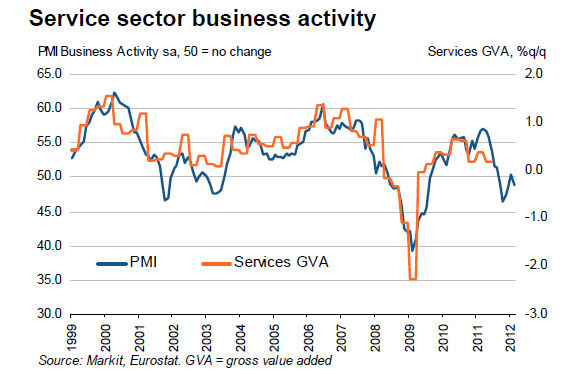
Eurozone Services and Composite PMI Back in Contraction; Italy, Spain, France at New Lows
Eurozone Services and Composite PMI Back in Contraction; Italy, Spain, France at New Lows
Markit Eurozone Services and Composite PMIs show renewed contraction due to drop in services activity, making it extremely difficult to deny that Europe is in a recession. Let's take a look at some numbers.
Markit Eurozone Composite PMI®
Note that prices received fell for the fifth month in six, but prices paid rose for the twenty-seventh straight month.
Let's take a look at the second biggest economy, France, to see what is coming up.
Markit Eurozone Composite PMI®
The Markit Eurozone PMI® Composite Output Index fell from 50.4 in January to 49.3 in February, dropping below the earlier flash estimate of 49.7. The final reading confirmed that business activity contracted in February, having briefly returned to growth in January following four months of decline at the end of last year.Markit Eurozone Services PMI®
Key points:
- Final data confirm slide back into contraction, as drop in services activity offsets marginal rise in manufacturing output
- Strong downturns still evident in Italy and Spain
- Employment and prices charged fall as firms seek to cut costs and win new sales


Service sector weakness poses new recession riskProfit Squeeze
Key points:
- Service sector activity contracts for fifth time in six months
- Ongoing fall in new business leads to job losses
- Growth in Germany contrasts with steeper declines in Italy and Spain
- Business confidence hits seven-month high
Of the four largest euro countries, only Germany showed expansion in February, and the rate of growth slowed from January’s seven-month high. The French service sector stagnated, ending a two-month period of mild expansion. Both Spain and Italy registered steep contractions, with the rates of decline gathering momentum in both cases.
Nations ranked by business activity (February)
- Ireland 53.3 12-month high
- Germany 52.8 2-month low
- France 50.0 3-month low
- Italy 44.1 4-month low
- Spain 41.9 3-month low
Spanish service providers reported a further particularly steep drop in payroll numbers, and employment also fell sharply in Italy’s service sector. French headcounts rose only slightly, while services employment growth in Germany slowed to the weakest since June 2010.
Companies frequently sought to boost sales by cutting prices, and average prices charged for services fell for the fifth time in the past six months as a result. Price trends varied markedly by country, however, ranging from ongoing upward pressure in Germany to steep falls in Spain and, to a lesser extent, Italy. France registered a slight fall in prices charged for services, reflecting the stagnation of new business flows in February.
In contrast to the trend for charges levied by service providers, input prices in the sector rose for the twenty-seventh straight month, pushed up in many instances by higher fuel and energy prices.
Note that prices received fell for the fifth month in six, but prices paid rose for the twenty-seventh straight month.
Let's take a look at the second biggest economy, France, to see what is coming up.
3 Charts On The US Consumption Crash Dead-Ahead
3 Charts On The US Consumption Crash Dead-Ahead
Average US gas prices are over 13% higher since late December 2011, back at June 2011 levels, and do not look set to drop any time soon. The anecdotal impact of this rise in a significant segment of the real US consumer's spending habits is unmistakable, as we discussed earlier, but it is more important to note where we have come from when considering the macro impact. Q4 macro data was 'juiced' by the significant drop in the price of energy as the 4-5pt drop in Energy-and-Utilities spend enabled 'visible' consumption to rise during that time (obviously helped by government handouts also). Just as occurred in the latter part of 2008, as the consumer was forced to spend more on Energy, so the visible consumption dropped notably and given the significance of the current data 'drop' in energy spending, when the current gas prices filter into this data, we would expect, as Credit Suisse points out, consumption on more discretionary spending will drop significantly.
Gas prices are up very significantly (both absolutely and on average)...

but the 'forced' rise in Energy spending has not filtered into the data yet...

...and just as in late 2008, as the spend of Energy and Utilities rises, so discretionary spending will drop significantly and given the huge divergence in the last quarter or two, the reaction could be very significant.

Perhaps this is just the 'crash' that Bernanke needs to run-the-presses again as conditionality will increasingly force investors to reject the 'optimal' buy-and-keep-buying trend as they recognize that QE3 can't start until things get worse, and buying in anticipation of QE3 means it will never happen?
Charts: Bloomberg
Gas prices are up very significantly (both absolutely and on average)...

but the 'forced' rise in Energy spending has not filtered into the data yet...

...and just as in late 2008, as the spend of Energy and Utilities rises, so discretionary spending will drop significantly and given the huge divergence in the last quarter or two, the reaction could be very significant.

Perhaps this is just the 'crash' that Bernanke needs to run-the-presses again as conditionality will increasingly force investors to reject the 'optimal' buy-and-keep-buying trend as they recognize that QE3 can't start until things get worse, and buying in anticipation of QE3 means it will never happen?
Charts: Bloomberg
Thursday, March 1, 2012
2/29/12 Sen. Snowe: We can't even do regular business
http://www.cbsnews.com/8301-18563_162-57388130/sen-snowe-we-cant-even-do-regular-business/
Sen Snowe: has decided to resign from Congress. The link above is to a CBS news video and Snowe gives her reasons for her resignation. A disturbing and informative interview on the inner workings of the political system that continues to fail.
Sen Snowe: has decided to resign from Congress. The link above is to a CBS news video and Snowe gives her reasons for her resignation. A disturbing and informative interview on the inner workings of the political system that continues to fail.
Tuesday, February 21, 2012
Market Update 02/21/12

Submitted by: Francis Soyer
Hi folks!,
It has been a while since I have written. The truth of the matter is there is not a heck of alot to talk about. Yes the ECB continues to kick the can down the road with one BS bailout plan after another with no real cure of realistic plan for a way for Greece to stay in the ECB.
Other than that we have day after day of Fed Pomo with no volume participation in the market from either institutional investors or non pro and retail whatsoever. Therefore the Fed is in the drivers seat and a drift up stairstep style that began in late December has continued un abated. That said I think it reasonable to expect the same for as long as a few weeks from now where we may see a turning point in the market. Until then an uptick to break up the boredom.
Subscribe to:
Posts (Atom)